


 PLATFORM UPDATE:

Hydrogen-bonding assisted nano-aggregation and electropolymerization of a C3-D–A-s-triazine-2,4,6-triamide for high-area-capacitance supercapacitors
 a
and
Man-kit
Leung
*ab
a
and
Man-kit
Leung
*ab
Abstract
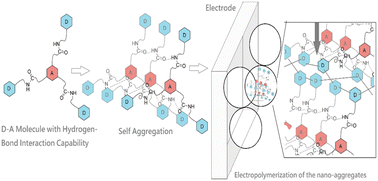
Fabricating strictly organic, highly porous electrodes without sacrificial templates or additives remains a formidable challenge for energy storage devices. Herein, we report a novel additive-free strategy for constructing hierarchically porous polytriphenylamine networks via the synergy of supramolecular pre-assembly and in situ electrochemical welding. A C3-symmetrical donor–acceptor monomer, 1,3,5-s-triazine-2,4,6-tri(phenyl-para-((diphenylaminophenyl)carboxamide) (TRZ-A-TPA), was rationally designed to spontaneously self-assemble into nanoaggregates driven by intermolecular hydrogen bonding and π–π interactions. Upon anodic sweeping, these pre-adsorbed aggregates act as primary nucleation seeds and are covalently “welded” together via para–para C–C (benzidine) coupling. The dynamic solvent-induced swelling of this hydrogen bonding and covalent hybrid network effectively opens the microporous channels, drastically lowering the interfacial charge-transfer resistance. This unique hierarchically porous morphology maximizes the accessible electrochemically active surface area and shortens solid-state ion diffusion pathways. Consequently, the resulting pTRZ-A-TPA film delivers exceptionally fast charge-storage kinetics with an 82% surface-dominant capacitive contribution, a high areal capacitance of 218 mF cm−2 in an organic electrolyte, and robust long-term durability (maintaining ∼70% capacitance over 3000 cycles). This work provides a fundamental structure–property paradigm for designing high-performance supramolecular energy storage materials.
 Please wait while we load your content...


