


 PLATFORM UPDATE:


Mechanically programmable and stretchable Janus elastomer with bidirectional visible-infrared radiative modes for thermal regulation and adaptive camouflage

Abstract
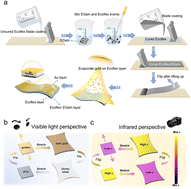
Flexible materials capable of multimodal regulation across visible and infrared spectra are promising for wearable systems, building energy management, and adaptive camouflage. Here, we present a multimodal optical-thermal Janus elastomer film that enables mechanically programmable and reversible switching of both its visible appearance and mid-IR emissivity. The film features a liquid metal (LM)/Ecoflex composite on one side and a thin gold (Au) coating on the other. Under tensile strain, the LM droplets flatten, increasing reflectance, while the Au layer develops microcracks, reducing reflectance and yielding an antagonistic emissivity response. Consequently, the film accesses four reversible optical-thermal states (gray/high-ε, silvery/low-ε, gold/low-ε, and dark-red/high-ε). From the unstretched state to strain, the LM side increases its broadband reflectance from 25.9% to 76.8%, while that of the Au side decreases from 81.0% to 32.8%. The film maintains >800% stretchability, asymmetric wettability, flame tolerance, and an EMI shielding of 28–35 dB. A global energy model projects 5–20 MJ m−2 year−1 radiative savings in high-insolation regions. Furthermore, the dual-channel (visible and IR) response supports mechanically encoded encrypted signaling and adaptive camouflage, enabling passive and reversible control of optical and thermal signatures.
 Please wait while we load your content...


