


 PLATFORM UPDATE:


Lattice-distortion engineering of zero-dimensional metal halide single crystals for high-performance scintillators
 *a
and
*a
and
Abstract
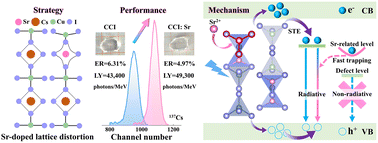
Cs3Cu2I5 (CCI) single crystals demonstrate excellent scintillation properties and are widely used in radiation detection. Despite the advantages of low cost and high controllability offered by the solution-growth method, the as-grown CCI crystals suffer from severe defects, which ultimately lead to poor energy resolution. In this work, using a room-temperature seed crystal induction solution-growth method, we propose a strategy in which Sr2+ doping induces lattice distortion in the [CuI3]2− triangular planes, thereby modulating the self-trapped exciton emission and defect capture processes. The corresponding dopant substitution site and the consequent reconstruction mechanism of the local coordination environment are elucidated by crystallographic characterization and structural analysis. Based on the results of these analyses, the large-sized Sr2+-doped CCI crystals present faster exciton recombination and lower non-radiative losses, resulting in an impressive energy resolution (4.97%) and light yield (49 300 photons/MeV) under 137Cs excitation. Our study elucidates the relationship between structural modification, luminescence properties and scintillation performance of CCI crystals, offering fundamental insights into how lattice distortion modifies their energy band structure.
- This article is part of the themed collection: Journal of Materials Chemistry C HOT Papers
 Please wait while we load your content...


