


 PLATFORM UPDATE:


Co-substitution of Zn2+/Ge4+ in Er3+-activated garnet phosphors to enhance luminescence properties and optical thermometry
 *a
and
Dawei
Zhang
a
*a
and
Dawei
Zhang
a
Abstract
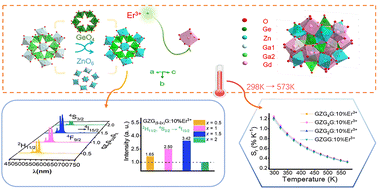
The gadolinium-gallium garnet has emerged as a promising candidate for preparing efficient luminescent materials; however, the luminescence properties of rare-earth activators in its solid solution phosphors are scarcely explored via crystal field engineering. In this work, Er3+-doped Gd3ZnxGa5−2xGexO12 (GZG5−2xG:Er3+) solid solutions were prepared by a high-temperature solid-state reaction, where a heterovalent co-substitution strategy was implemented by introducing the Zn2+/Ge4+ pair to replace 2 Ga3+ sites. Rietveld refinements of X-ray diffraction data confirmed that all samples crystallized in the pure garnet phase. Upon 381 nm excitation, the Er3+ concentration was spectrally optimized to be about 10%, substituting for the Gd3+ sites, and via Zn2+/Ge4+ co-substitution, the luminescence intensity of GZG2G:10%Er3+ increased by more than threefold compared with that of the baseline GZGG:10%Er3+ sample. All the GZG5−2xG:10%Er3+ solid solution samples showed a bright green color under illumination using an ultraviolet lamp at ∼365 nm. The thermometric properties of the thermally coupled levels of Er3+ 2H11/2-4S3/2 were systematically studied on the basis of the fluorescence intensity ratio principle. The GZG5−2xG:10%Er3+ samples can perform temperature sensing over a wide temperature range of 298–573 K, with a maximum relative sensitivity (Sr) above 1.20% K−1 and an applicable minimum temperature resolution (δT) around 0.4 K. Continuous exploration of solid solution-manipulating luminescence properties could lead to the development of novel thermometry probes (particularly for activators with spin-allowed transitions) with higher Sr and smaller δT for practical optical temperature sensing.
- This article is part of the themed collection: Journal of Materials Chemistry C HOT Papers
 Please wait while we load your content...


