


 PLATFORM UPDATE:


Biocompatible and structurally stable near-spherical PLNP@PDA@PW12 nanoplatforms for precise temperature sensing and photothermal therapy

Abstract
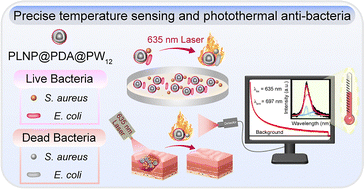
Near-spherical core–shell PLNP@PDA nanoplatforms with an average diameter of 58.6 nm were successfully synthesized by covalently conjugating persistent luminescent nanoparticles (Zn2Ga2.96Ge0.75O8:Cr0.023+,W0.016+@SiO2–NH2, PLNPs) with polydopamine (PDA) photothermal agents via Michael addition and Schiff base reactions. Compared to electrostatic self-assembly nanoplatforms, the constructed core–shell PLNP@PDA@PW12 nanoplatforms (58.8 nm) maintained structural integrity even after simulated circulation at a high-speed of 4 m s−1 (ten times higher than the average blood flow velocity) for 1 h, demonstrating their remarkable structural stability attributed to the increased interfacial contact area and strong interactions between PLNPs and PDA. These core–shell nanoplatforms, benefiting from the inherent biocompatibility of PDA and the modification with phosphotungstic acid (PW12), exhibited excellent biosafety, maintaining 97.7% viability of mouse fibroblast cells (L929) at 200 µg mL−1. In particular, the constructed core–shell nanoplatforms exhibited a high photothermal conversion efficiency of 49.7% under 635 nm excitation, owing to the pronounced photothermal effect of PDA. In vitro tests demonstrated bacterial eradication rates of 93.6% against Staphylococcus aureus (S. aureus) and 94.4% against Escherichia coli (E. coli) after four treatments with a human-safe laser dose (0.2 W cm−2) penetrating 3 mm of tissue. In in vivo bacterial-infected wound models, the PLNP@PDA@PW12 nanoplatforms increased the local tissue temperature within the wound under 635 nm laser irradiation, significantly inhibiting bacterial infection and accelerating wound healing. These PDA-based core–shell nanoplatforms with superior stability, biocompatibility, tissue-penetrating antibacterial capacity, and afterglow-temperature-guided precision photothermal therapy are highly promising candidates for clinical applications.
 Please wait while we load your content...


