


 PLATFORM UPDATE:


Rational tuning of naphthalene diimide (NDI)-thienoisoindigo (TIIG) copolymer compositions for high-performance all-polymer photodetectors with broadband response from 300 nm to 1050 nm

Abstract
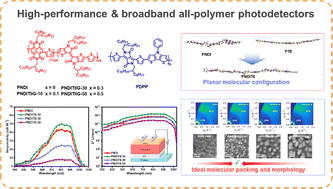
A series of acceptor polymers with broadband spectral absorption were rationally designed by copolymerizing two strong electron-withdrawing units, naphthalene diimide (NDI) and thiophene isoindigo (TIIG), with systematically varied incorporation ratios. The pristine NDI-based polymer exhibited large dihedral angles, resulting in limited backbone planarity and suboptimal intermolecular packing. Introducing TIIG significantly improved molecular coplanarity and π–π stacking, yet excessive TIIG content raised the LUMO energy level, adversely affecting energy level alignment. When blended with a broadband-absorbing donor polymer (PDPP), the PDPP:PNDITII-10 blend achieved optimal molecular stacking and film morphology. Benefiting from balanced energy levels, enhanced aggregation, and efficient charge transport, the resulting all-polymer photodetector exhibited a remarkable spectral response from 300 nm to 1050 nm, a maximum responsivity of 50.0 mA W−1, and a peak specific detectivity of 1.6 × 10¹² Jones at −0.1 V. Notably, across the 350–1040 nm range, the specific detectivity consistently exceeded 1011 Jones.
 Please wait while we load your content...


