


 PLATFORM UPDATE:


Two magnesium-based metal–organic frameworks (Mg-MOFs): structures, photochromism, and fluorescence sensing of Fe3+ ions and cysteine molecules
 *a
Xiao-Ying
Huang
a
*a
Xiao-Ying
Huang
a
Abstract
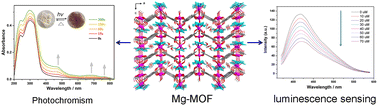
In this work, two magnesium-based metal–organic frameworks (Mg-MOFs) assembled from 1,4-naphthalinic acid (1,4-H2NDC) and pyridine-containing ligands, namely, 1,2-di(4-pyridyl)ethylene (L1) or 2-di(pyridin-4-yl)diazene (L2), are presented and characterized. In these two compounds, L1 or L2 acts as terminal ligands coordinated to Mg2+ ions in the binuclear second building units (SBUs) to generate two-dimensional (2D) [Mg2(1,4-NDC)2(H2O)(L)]·6H2O networks (where L = L1 for 1 and L = L2 for 2). Although compounds 1 and 2 are constructed from ligands that are not intrinsically photoactive, both compounds exhibit photochromic behavior, representing the first reported two-dimensional (2D) photochromic Mg-MOFs achieved from coordination between Mg2+ and the non-photochromic organic ligands. Moreover, compound 1 displays bright blue luminescence and can function as a selective luminescent sensing material towards Fe3+ ions. When modified with CuI, it exhibits dual emission and shows luminescence sensing ability for cysteine (Cys) molecules as well. This work provides a useful reference for designing luminescent sensing MOFs using earth-abundant metals.
 Please wait while we load your content...


