


 PLATFORM UPDATE:


Pressure-induced structural transitions and metallization in two-dimensional semiconductor CuInP2S6
 *c
*c
Abstract
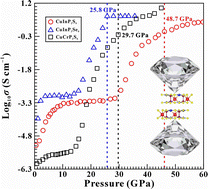
Copper indium thiophosphate CuInP2S6 (CIPS), an archetypal two-dimensional (2D) van der Waals (vdW) ferroelectric semiconductor, has spurred burgeoning research attention owing to its rich physics and broad application prospects. In this work, an in-depth investigation of the structural, vibrational and electrical transport behaviors of CIPS was performed up to 59.8 GPa using a diamond anvil cell (DAC) coupled with in situ Raman spectroscopy, micro-area X-ray diffraction (XRD) and electrical conductivity measurements under different hydrostatic environments. Under non-hydrostatic pressurization, CIPS underwent a Cc-to-P![[3 with combining macron]](https://www.rsc.org/images/entities/char_0033_0304.gif) 1m structural transition at 7.2 GPa and then transitioned to an unknown phase at 26.9 GPa, followed by metallization at 47.8 GPa. The comparable Cc-to-P1m structural transformation pressure and ∼4.0 GPa pressure hysteresis for the appearance of unknown and metallic phases under hydrostatic conditions can be ascribed to the influence of deviatoric stress. Furthermore, the empirical relation between metallization pressure and constituent elements was elucidated in CuMP2X6 (M = Cr and In; X = S and Se). Upon decompression, the irrecoverable Raman spectra and electrical conductivity magnitude demonstrated the irreversibility of phase transition in CIPS under different hydrostatic environments. These insights into CIPS not only deepen our understanding of the physicochemical characteristics of other 2D vdW ferroelectrics under extreme conditions but also pave the way for the development of relevant high-performance multifunctional devices.
1m structural transition at 7.2 GPa and then transitioned to an unknown phase at 26.9 GPa, followed by metallization at 47.8 GPa. The comparable Cc-to-P1m structural transformation pressure and ∼4.0 GPa pressure hysteresis for the appearance of unknown and metallic phases under hydrostatic conditions can be ascribed to the influence of deviatoric stress. Furthermore, the empirical relation between metallization pressure and constituent elements was elucidated in CuMP2X6 (M = Cr and In; X = S and Se). Upon decompression, the irrecoverable Raman spectra and electrical conductivity magnitude demonstrated the irreversibility of phase transition in CIPS under different hydrostatic environments. These insights into CIPS not only deepen our understanding of the physicochemical characteristics of other 2D vdW ferroelectrics under extreme conditions but also pave the way for the development of relevant high-performance multifunctional devices.
 Please wait while we load your content...


