


 PLATFORM UPDATE:


Irreversible thermochromic Pb2Sn2O6·xH2O: competition between weak ligand H2O and lone-pair electrons
 *c
and
Jiaqi
Zhang
*a
*c
and
Jiaqi
Zhang
*a
Abstract
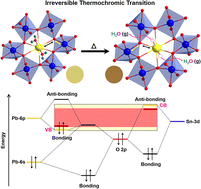
Many post-transition-metal based compounds have been reported as thermochromic materials. However, the thermochromic effect of crystalline water induced conduction band minimum competition between sp3 non-equivalent hybridized O2s and O2p orbitals and lone-pair electrons from post-transition-metal oxides has not been elucidated. Herein, we provide a new model compound, Pb2Sn2O6·xH2O, to realize dynamic competition at the bottom of the conduction band minimum in a thermochromic process. Two different hydrothermal methods were applied to synthesize the Pb2Sn2O6·xH2O samples. A color change from light yellow to reddish brown was found for the samples. The difference in color mutation temperature point is attributed to the different lattice energy and water content of the two samples. The irreversible thermochromic phenomenon results from dehydration with the temperature-sensitive loss of crystalline water in the lattice. However, due to the strong coupling between the crystal structure and the electronic structure, the 6s2 lone pair of electrons repel each other due to heating, resulting in a decrease in the distance between Pb and O, and the Pb6s–O2p hybrid anti-bonding state is promoted to a higher energy, and the band gap decreases, thereby reducing the energy required for charge transfer. Our work not only provides a new dehydration-type inorganic irreversible thermochromic material, but also fully elucidates the interaction mechanism and band gap relationship between lone pair electrons and oxygen. It also provides a new idea to adjust the thermochromic rate and color mutation temperature point by changing the lattice energy and water content, which is important to design new inorganic thermochromic materials.
 Please wait while we load your content...


