


Room temperature red phosphorescence: enhancing and regulating phosphorescence by exploiting intermolecular halogen interactions and thermal stimuli
 *a
Takuma
Yasuda
*de
*a
Takuma
Yasuda
*de
Abstract
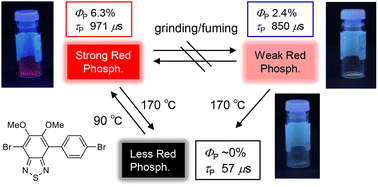
Longer-wavelength red phosphorescence emissions are important owing to their practical applications in organic light-emitting diodes as well as biological imaging and sensing. In addition to new concepts for enhancing red phosphorescence, stimulus-responsive phosphorescence regulation is expected to expand the applications field by providing new functionalities. However, external-stimulus-responsive red phosphorescence is rare and challenging to engineer in chemistry. In this paper, we report enhancing and regulating red phosphorescence by exploiting intermolecular halogen interactions and thermal stimuli. A benzothiadiazole (BTD) dye bearing an aromatic moiety and a bromine atom on the BTD core exists as a pair of crystal polymorphs, one of which is weakly phosphorescent, whereas the other is strongly phosphorescent. An intermolecular halogen interaction in the latter enhances intersystem crossing and subsequent radiative transitions, resulting in strong red phosphorescence. The two polymorphs respond to external thermal stimuli; consequently, the strongly and weakly phosphorescent states can be used to regulate phosphorescence intensity via a less-phosphorescent state.
 Please wait while we load your content...


