


Recent advances in design and preparation of abrasives for chemical mechanical polishing of hard-brittle materials
 *abd
Jiakai
Zhou,
*abd
*abd
Jiakai
Zhou,
*abd
Abstract
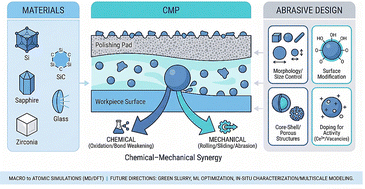
Hard-brittle materials (e.g., monocrystalline silicon, SiC, and sapphire) are crucial for optoelectronics, semiconductors, and precision optics due to their excellent mechanical and thermal properties. Chemical mechanical polishing (CMP) is the most effective method for achieving ultra-precise, low-damage surfaces of these materials, where abrasives play a key role in balancing the material removal rate (MRR) and surface quality. This review systematically summarizes the latest progress in the design and preparation of CMP abrasives, including the development of abrasives, precision control of morphology and particle size, surface modification, and construction of functional structures. Additionally, CMP process modeling has advanced from empirical macro-models to nanoscale theoretical simulations, supporting research on atomic-scale material removal mechanisms via molecular dynamics and quantum chemical calculations. By elaborating on the applications of abrasives in polishing hard-brittle materials, this review further indicates that the core mechanism of CMP is chemical–mechanical synergy. Chemical reactions (such as Ce–O–Si bond formation and oxide layer generation) weaken the chemical bonds on the material surface, while the mechanical effects of abrasives (grinding, rolling, and sliding) realize material removal. Interfacial tribochemistry and multiphysics field coupling (mechanical, chemical, and thermal) further regulate the polishing effect. Despite considerable progress, challenges remain (e.g., improving the dispersion stability of abrasives, minimizing subsurface damage, and promoting the industrialization of green technologies). Future research will focus on the industrialization of green slurries, the optimization of abrasive formulations and process parameter control via machine learning technology, and the clarification of interfacial micro-mechanisms through in situ characterization technology and multi-scale coupling simulation methods. This review provides theoretical and technical support for the high-efficiency, low-damage, and green ultra-precision machining of hard-brittle materials.
- This article is part of the themed collections: Journal of Materials Chemistry C Recent Review Articles and Journal of Materials Chemistry C HOT Papers
 Please wait while we load your content...


