High-throughput in situ fabrication of fibrous membranes enables scalable passive radiative cooling

Abstract

Deploying fibrous membranes for passive daytime radiative cooling (PDRC) on large and irregular surfaces is highly desirable but remains challenging, owing to the slow deposition rates and the need for electrically conductive substrates in conventional electrospinning. Here, we demonstrate a high-throughput in situ strategy for fabricating nanocomposite PDRC fibrous membranes via solution blow spinning. This method achieves deposition rates 8–12 times faster than electrospinning and can be applied directly onto nonplanar, nonconductive objects. The resulting membranes, composed of styrene–ethylene–butylene–styrene (SEBS) fibers embedded with Y2O3 nanoparticles, achieve sub-ambient cooling of up to 7.0 °C outdoors, effectively delaying ice melting. Moreover, they are fully recyclable through simple cleaning, dissolution, and reprocessing. This scalable and sustainable fabrication route provides a versatile and practical platform for integrating PDRC fibrous membranes across diverse surfaces, paving the way toward real-world thermal management applications.
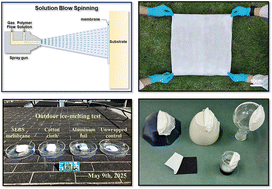
Graphical abstract: High-throughput in situ fabrication of fibrous membranes enables scalable passive radiative cooling

Supplementary files

Transparent peer review

To support increased transparency, we offer authors the option to publish the peer review history alongside their article.

View this article’s peer review history

Article information

Article type
Paper
Submitted
24 Dec 2025
Accepted
09 Feb 2026
First published
10 Feb 2026

J. Mater. Chem. C, 2026, Advance Article

High-throughput in situ fabrication of fibrous membranes enables scalable passive radiative cooling

H. Shao, X. Huang, X. Huang, J. Zhao, N. Xing, H. Xu, W. Song and Y. Lu, J. Mater. Chem. C, 2026, Advance Article , DOI: 10.1039/D5TC04498G

To request permission to reproduce material from this article, please go to the Copyright Clearance Center request page.

If you are an author contributing to an RSC publication, you do not need to request permission provided correct acknowledgement is given.

If you are the author of this article, you do not need to request permission to reproduce figures and diagrams provided correct acknowledgement is given. If you want to reproduce the whole article in a third-party publication (excluding your thesis/dissertation for which permission is not required) please go to the Copyright Clearance Center request page.

Read more about how to correctly acknowledge RSC content.

Social activity

Spotlight

Advertisements