


 PLATFORM UPDATE:


Linear temperature dependence of intrinsic resistivity of metals determined by the electronic structure
 *a
*a
Abstract
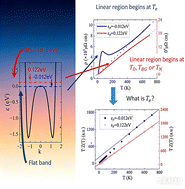
The temperature dependence of the intrinsic resistivity (ρ) limited by electron–phonon scattering is a significant physical property of metals. When the temperature (T) is sufficiently high, the ρ–T relationship becomes linear for all metallic materials. According to conventional Bloch–Grüneisen theory, the characteristic temperatures for the onset of the linear ρ–T relationship are defined by the Debye temperature (TD) or the Bloch–Grüneisen temperature (TBG), both of which are closely associated with the phonon dispersion. In the present work, we propose a novel characteristic temperature (Te) to govern the linear ρ–T relationship that arises from the electronic structure, unrelated to the phonon dispersion. By performing first-principles calculations, we demonstrate that rhombohedral trilayer graphene can exemplify such an electronic structure that determines a linear ρ–T relationship. We expect that, in addition to other characteristic temperatures, such as TD and TBG, the effect of Te should be considered when analysing the temperature dependence of the intrinsic resistivity of materials with band singularities, such as the flat bands or band edges, occurring close to the Fermi level.
 Please wait while we load your content...


