


Unravelling the role of various interactions in mechanochromism-induced polymorphism: a sensor kit for acidic fume detection and double encryption–decryption technologies

Abstract
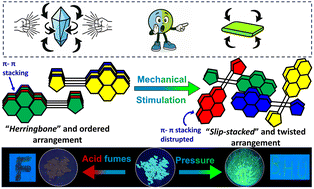
The majority of the previously reported mechanochromic materials display crystalline to amorphous transitions, thereby inhibiting detailed investigations on their mechanistic properties. Additionally, developing a multi-stimuli responsive system is critical for sensor and security technologies. In this context, a pyrene-based derivative, (E)-N′-(anthracen-9-ylmethylene)furan-2-carbohydrazide (PCFH), displays aggregation-induced emission (AIE), mechanochromism and acidochromism. It exhibits a relatively rare, reversible red-shifted enhanced emission upon the application of a mechanical force. Herein, the mechanochromism-induced crystal-to-crystal transition is reported, and the structural changes at the molecular level are investigated with the aid of PXRD, SCXRD, DSC and Hirshfeld surface analysis. This study is one among the rare works that present single crystals of both polymorphs in pyrene-based materials. The mechanically induced enhancement of molecular planarity facilitates ICT processes and alters the supramolecular arrangement from robust π–π stacking to C–H⋯π interactions, leading to red-shifted enhanced emissions. The acid-sensitive property of PCFH is successfully utilized in devising a portable sensor kit for acidic fumes. Additionally, acidochromism and mechanochromism are synergistically exploited to design a multi-level data encryption and decryption system. Furthermore, the PCFH-coated papers have practical applications in pressure sensing and rewritable pressure printing technologies.
 Please wait while we load your content...


