



Tuning from nanoparticles to nanorods: experimental and theoretical investigation of La-doped CdTe for enhanced photoresponse
 *a
*a
Abstract
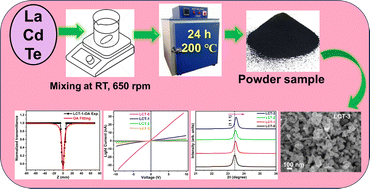
Cadmium telluride (CdTe) nanoparticles have become an interesting material for various research applications due to their outstanding optoelectronic properties and structural flexibility. In this study, four La-doped CdTe (LCT) nanomaterials were grown using the hydrothermal method to examine the effect of La addition on their optical, structural, and optoelectronic characteristics. With increasing La concentration, a morphological transition from nanoparticles to a nanoparticle–nanorod hybrid structure was shown by field emission scanning electron microscopy (FESEM) analysis. The cubic CdTe phase was validated by X-ray diffraction (XRD) patterns, and the material's unique vibrational modes were revealed by Raman spectroscopy. The chemical composition and oxidation states of the constituent elements were further revealed by X-ray photoelectron spectroscopy (XPS) spectra. With increasing La content, the optical bandgap showed red-shift behaviour, decreasing from 2.17 eV to 2.06 eV, while the refractive index (n) increased from 2.57 to 3.44. Photoresponse studies showed that all samples exhibited increased photocurrent under illumination compared to dark conditions. Additionally, all samples exhibited reverse saturable absorption (RSA) behaviour, as confirmed by nonlinear optical (NLO) analysis, which revealed positive nonlinear absorption coefficients. These results indicate that La-doped CdTe nanostructures, particularly the LCT-0 sample, have considerable potential for use in nonlinear optical devices and high-performance photodetectors.
 Please wait while we load your content...


