


Exploring magnetodielectric and negative differential resistance effects in NiMn2O4 nanocomposites

Abstract
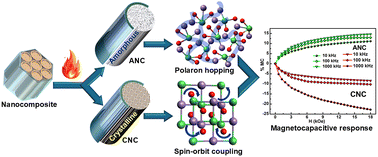
NiMn2O4 (NMO) composites confined within ordered mesoporous silica were synthesized following a sol–gel process. These samples were investigated to examine the structural, electrical, and magnetic properties of materials fabricated in two distinct forms: amorphous nanocomposites (ANCs) and crystalline nanocomposites (CNCs). TGA analysis was used to determine the annealing temperatures. A thorough analysis was conducted to look at the structure, I–V, and magnetic properties of ANC and CNC samples. The microstructural variation was examined using XRD and TEM, while XPS revealed distinct valence states of Mn and Ni. These states give rise to a variety of magnetic interactions, including Mn2+–O–Mn3+ and Mn3+–O–Mn4+, as well as ferromagnetic and antiferromagnetic interactions. These interactions further led to the positive and negative magnetodielectric and negative differential resistance (NDR) effects. The DC magnetization studies demonstrated the existence of the memory effect in CNCs. To gain more insight into the type of magnetic interaction taking place in the sample, the exchange bias (EB) was also examined. The incorporation of transition metal ions can significantly alter the electrical and magnetic properties of these nanocomposites, making them suitable for various applications in electronics and sensors. These tailored properties are especially valuable in the development of magnetic sensors and memory devices, where precise control over magnetoresistance (MR) is crucial.
 Please wait while we load your content...


