


 PLATFORM UPDATE:


Achieving broadband NIR emission through multiple centers of isolated Cr3+ and Cr3+–Cr3+ ion pairs resulting from phase segregation in SrLa2Ga2O7

Abstract
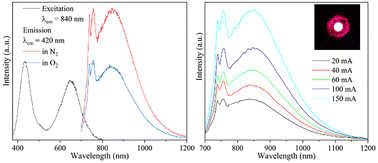
Cr3+-doped broadband near-infrared (NIR) phosphors are strongly sought after for emerging applications in spectroscopy and optical communication. A novel phosphor material activated by Cr3+, designed with a Ruddlesden–Popper double-layer perovskite structure, was developed in this research. We successfully synthesized the SrLa2Ga2O7:Cr3+ (SLG:Cr) phosphor via a conventional high-temperature solid-state reaction. This phosphor exhibits an ultra-broad emission spanning 700–1200 nm, originating from three distinct emission centers: Cr3+ doped into the host SLG lattice (weak crystal field, 4T2 → 4A2 transition), isolated Cr3+, and Cr3+–Cr3+ ion pairs doped into the impurity phase La4GaO9 (strong crystal field, 2E → 4A2 transition). Optimal performance was achieved at 0.4% Cr3+ doping concentration. At this level, the phosphor exhibited its highest performance, producing a broad emission band with a full width at half maximum (FWHM) of 231 nm upon excitation with 430 nm blue light. Notably, sintering under an N2 atmosphere significantly enhanced both luminescence intensity and thermal stability, with the phosphor maintaining 88.31% of its room-temperature emission intensity at 420 K (thermal activation energy ΔE = 0.41 eV). Meanwhile, the internal quantum efficiency (IQE) and external quantum efficiency (EQE) were improved to 81% and 30%, respectively. The output power of the pc-NIR-LED based on the SLG:0.4% Cr3+ phosphor and a 430 nm chip reached 90.75 mW@150 mA. The unique multi-center emission mechanism and controllable synthesis conditions demonstrated in this work provide new insights for designing high-performance broadband NIR phosphors destined for next-generation light-emitting devices.
 Please wait while we load your content...


