


 PLATFORM UPDATE:

Neodymium chloride doping and homogeneous passivation in CsPbBr3 nanocrystals for efficient blue light-emitting diodes

Abstract
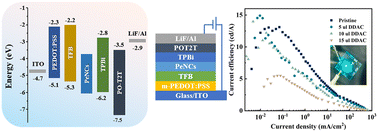
Perovskite light-emitting diodes (PeLEDs) hold significant potential for display and lighting applications. However, their development has been hindered by intrinsic issues, including limited material stability, insufficient efficiency, and challenges in achieving high spectral purity and a wide color gamut. In this work, efficient blue light PeLEDs were obtained through multiple modifications of the doping strategy and surface passivation. Incorporation of NdCl3 into CsPbBr3 perovskite nanocrystals (PeNCs) results in lattice contraction, which enhances crystallization quality and increases the photoluminescence quantum yield (PLQY), thereby reducing non-radiative recombination. Further homogeneous passivation with didodecyl dimethylammonium chloride (DDAC) can effectively fill the halogen vacancies on the surface of PeNCs, thus reducing surface defects. Ultimately, the PeLEDs achieved the highest external quantum efficiency (EQE) of 15.74% at an emission wavelength of 478 nm. This study can provide important insights into the multi-component regulation of high-performance blue light PeLEDs and build the foundation for their practical application in full-color displays.
 Please wait while we load your content...


