


 PLATFORM UPDATE:


Broadband photoluminescence of epitaxial bismuth nanowires and planar nanostructures

Abstract
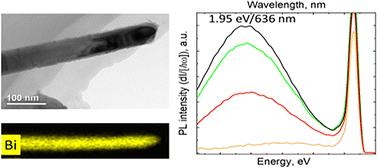
Bismuth nanostructures represent a promising material platform for semiconductor nanooptoelectronics and colorimetry owing to the multi-colored light reflection and quantum confinement. In this work, we study the photoluminescent properties of bismuth nanostructures grown using molecular beam epitaxy on the planar CaF2/Si(111) surface. We demonstrate the different surface morphologies of Bi, ranging from planar films obtained at a low growth temperature to island nano-arrays at elevated temperatures. The formation of individual bismuth nanowires is also demonstrated. Broadband photoluminescence of bismuth in the visible spectral range is revealed for both planar layers and nano-island arrays, as well as nanowires. The role of Bi3+ ions in photoluminescence is excluded by covering Bi nanostructures with an epitaxial CaF2 capping layer preventing bismuth from ambient humidity and oxidation. According to the performed density functional theory calculations, the nature of broadband photoluminescence is associated with interband transitions, accompanied by intraband phonon scattering.
 Please wait while we load your content...


