



Design of a ppb-level gas sensor based on hollow nanosphere structures for H2S detection in aerospace environments

Abstract
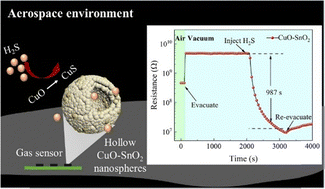
Detecting hydrogen sulfide (H2S) is crucial for aerospace applications, as it is commonly present in planetary soils. However, the vacuum conditions encountered in aerospace, characterized by ultra-low pressure and oxygen-deficient atmospheres, pose significant challenges for conventional sensors. In this paper, we report the design and fabrication of a ppb-level H2S gas sensor based on hollow CuO–SnO2 nanosphere structures (∼200 nm). Remarkably, the sensor achieves the reliable detection of H2S at concentrations as low as 50 ppb, even under high-vacuum conditions (∼3 × 10⁻³ Pa). Moreover, it maintains stable sensing performance from room temperature (25 °C) to sub-zero environments (−40 °C), with responses of 464.6 and 3.9 toward 5 ppm H2S, respectively. Unlike conventional sensors that rely on oxygen vacancies and require ambient oxygen to function, our sensor exploits a direct chemical reaction between CuO and H2S, enabling efficient operation in oxygen-free vacuums. The hollow nanosphere architecture enhances gas adsorption, while a built-in p–n heterojunction provides charge modulation independent of oxygen. This synergistic structural and electronic design delivers ppb-level H2S sensing under extreme vacuum conditions, positioning CuO–SnO2 nanospheres as a versatile platform for gas sensing in both ambient and aerospace environments.
 Please wait while we load your content...


