


 PLATFORM UPDATE:


Synthesis and halochromic behavior of resorufin-based monomer, and redox-responsive optical properties of both monomer and polymer
 *a
*a
Abstract
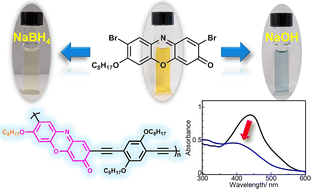
Resorufin exhibits reversible structural transformation to its reduced form, dihydroresorufin, through alternating redox reactions. This dynamic redox behavior enables a highly efficient fluorescence turn-on/off response. The transformation involves bond formation and cleavage within the π-conjugated system of the resorufin core, making it a promising candidate for molecular switching applications. Owing to these unique properties, resorufin serves as a potent building block for the development of smart, stimuli-responsive materials. Herein, we report a soluble resorufin monomer (2,8-dibromo-7-octyloxyresorufin) and a novel resorufin-based π-conjugated polymer. The halochromism of the resorufin monomer was first investigated. The optical spectral changes of both monomer and polymer during the reduction and oxidation processes were investigated by UV-vis spectra upon the addition of a NaBH4/EtOH solution as a reductant and HNO3 aqueous solution as an oxidant. Remarkable color changes were observed for both the resorufin monomer and polymer. These findings indicate the potential of developing stimuli-responsive materials based on π-conjugated compounds incorporating a resorufin backbone.
 Please wait while we load your content...


