


Room-temperature aqueous ZnAgSe alloyed quantum dots: Zn-assisted defect passivation for bright NIR emission and biointerface-ready colloids
 a
Caner
Ünlü
*a
a
Caner
Ünlü
*a
Abstract
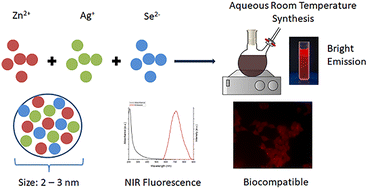
Cadmium-free, near-infrared (NIR) emissive quantum dots prepared by green aqueous routes are attractive for optical sensing. However, single-step, room-temperature synthesis of alloyed II–VI QDs typically suffers from cation disorder and surface traps that decrease photoluminescence quantum yield (PLQY) and reproducibility. Here we report ambient, one-pot aqueous synthesis of Zn–Ag–Se alloyed QDs stabilized by L-glutathione (L-GSH) that achieve an absolute PLQY of up to 20.2% in water without shelling. Systematic control of the Zn : Ag precursor mol ratio (8 : 1 → 1 : 1) modulates surface charge (−17.8 → −6.5 mV), suppresses non-radiative decay, and decreases the dominant time-resolved PL lifetime (τ2 ≈ 155 → 97 ns). This study establishes a quantitative surface-charge–PLQY–lifetime relationship. Structural analysis confirms Zn–Ag–Se alloying with L-GSH ligation; compositional analysis indicates a near-surface Zn enrichment consistent with reduced trap density. The QDs exhibit size- and composition-tunable NIR emission (λmax = 650–830 nm). They also show polarity-dependent “turn-on” photoluminescence (PL) with up to ∼320% enhancement in high-fraction DMF/MeOH and spectral coupling with chlorophyll that modulates excitation and emission bands. In addition, preliminary HEK293T assays indicate rapid internalization with negligible reactive oxygen species. This ambient, single-step aqueous route and the surface-charge-guided, Zn-assisted passivation provide an easy way to make scalable, Cd-free NIR-emitting colloids for sensing and biophotonics.
 Please wait while we load your content...


