


Manipulating the piezoelectric response of BCZT-based ceramics through BMS doping-controlled domain size and phase boundary engineering

Abstract
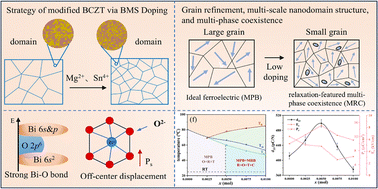
Perovskite ceramics with high piezoelectric properties show great potential for functional device applications. However, compared with the lead-based counterparts, achieving substantial performance improvements in lead-free ceramics remains a longstanding challenge. In this study, a novel strategy was proposed to construct a morphotropic relaxor boundary (MRB) through integrated phase boundary engineering and compositional design. In this design, relaxation-featured multi-phase coexistence (RMC) and multi-scale nanodomain were achieved by introducing Bi(Mg0.5Sn0.5)O3 (BMS) into a BCZT matrix. Results demonstrated that BMS doping effectively enhanced the relaxor behavior, inducing a transformation of the MPB structure into the MRB structure while refining the grain size and strengthening the spontaneous polarization capability. Moreover, piezo-response force microscopy (PFM) and AC-STEM analysis revealed pronounced local structural disorder and nanoscale multi-phase coexistence, which collectively facilitated polarization rotation and contributed to an improved piezoelectric response. As a result, the BCZT–0.005BMS ceramic exhibited excellent piezoelectric performance, with a high piezoelectric coefficient (d33) of 499 pC N−1, a remnant polarization (Pr) of 15.15 µC cm−2, and a coercive field (Ec) of 4.85 kV cm−1. In addition, a phase diagram was constructed based on Rietveld structural refinements and temperature-dependent dielectric measurements, illustrating the phase transition behavior. Phase-field simulations were also conducted to explore the domain evolution. This work offers an effective strategy for optimizing the piezoelectric performance of lead-free ceramics and highlights their strong potential for practical applications in environmentally friendly piezoelectric devices.
 Please wait while we load your content...


