


 PLATFORM UPDATE:


Photo-induced micro-phase separation structural changes for property regulation of circularly polarized luminescent liquid crystal physical gels

Abstract
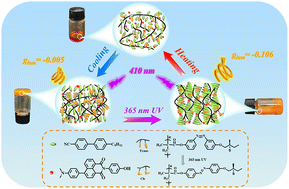
Photo-responsive circularly polarized luminescence (CPL) materials have attracted increasing attention due to their unique properties and promising applications in optical data storage and anti-counterfeiting technologies. In this research, photo-responsive CPL liquid crystal physical gels (LCPGs) that simultaneously exhibit photo-induced luminescence dissymmetry factor (glum) enhancement, excellent reversibility and robust fatigue resistance are prepared by doping chiral azobenzene-based liquid crystal polymer (S)-PAzoIsoxy with luminescent component MBHB and nematic liquid crystal 5CB. Prior to UV irradiation, (S)-PAzoIsoxy self-assembles within the 5CB and MBHB matrix to form a LCPG, resulting in a distinct micro-phase separation structure. At this stage, only a small amount of (S)-PAzoIsoxy dissolves in 5CB and MBHB, leading to weak chiral induction and low glum value. For instance, with 6 wt% (S)-PAzoIsoxy, the initial glum of LCPG is only −0.005. Upon UV irradiation, the gel network disassembles, increasing the concentration of dissolved (S)-PAzoIsoxy in 5CB and MBHB. This results in a substantial enhancement of glum value. For LCPG with 6 wt% (S)-PAzoIsoxy, the glum increases by a factor of 21.2 post-irradiation. Importantly, this change is fully reversible and exhibits excellent fatigue resistance. Upon heating, the glum value returns to its original state, and no measurable degradation is observed after multiple photo-thermal cycles.
 Please wait while we load your content...


