



Graphene layer-controlled bismuth ferrite nanocomposites with enhanced bandgap engineering and piezophotocatalytic activity
 *ab
and
Subhash
Sharma
*c
*ab
and
Subhash
Sharma
*c
Abstract
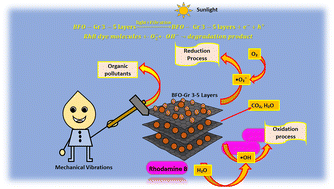
Bismuth ferrite–graphene (BFO–Gr) nanocomposites with controlled graphene layers (3–5 and 5–8 layers) were synthesized by sonication method and comprehensively investigated for their structural, magnetic, and piezo-photocatalytic properties. X-ray diffraction and TEM confirmed that BFO nanoparticles (∼90 nm) preserved the rhombohedral R3c phase and were uniformly anchored on graphene, with distinct lattice fringes corresponding to BFO(110) and graphene layers. Raman and FTIR analyses evidenced strong interfacial interactions mediated by oxygenated groups and defect modulation. Optical measurements revealed bandgap narrowing from 2.22 eV (BFO) to 1.90 eV (BFO–Gr-3–5), improving visible-light absorption and charge separation. XPS and VBS results showed Bi3+/Fe3+ stability, oxygen vacancy generation, and valence band edge shifts, which enhanced conductivity. Furthermore, magnetic and EPR analyses showed layer-dependent magnetization with improved spin-active defect states in the BFO–Gr-3–5 layer nanocomposite. Extraordinarily, piezoelectric measurements demonstrated a significant d33 enhancement from 26.56 pm V−1 (BFO) to 157 pm V−1 (BFO–Gr-3–5), which was attributed to defect passivation and strong interfacial coupling. Under coupled piezo-photocatalysis, BFO–Gr-3–5 demonstrated superior RhB degradation (∼90% in 40 min, k = 0.025 min−1), surpassing pristine BFO and BFO–Gr-5–8 layer composites. For further verification, electrochemical studies (CV, EIS, Mott–Schottky, and HRMS) and EPR with DMPO showed higher conductivity, and faster charge transfer. Scavenger tests and EPR confirmed the generation of active species. Overall, the BFO–Gr-3–5 layer nanocomposite outperforms pure BFO in all aspects, making it a multifunctional material for energy, catalysis, and sensing applications.
 Please wait while we load your content...


