


Arbitrary-ordered pulsed programming achieving 11 well-separated programming levels via a multilevel transistor–memristor series configuration
 *ab
*ab
Abstract
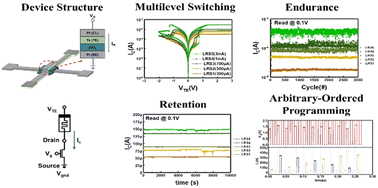
With the increasing demand for high-density nonvolatile memory and in-memory computing, multilevel resistive switching has emerged as a promising strategy to enhance information storage density and computational capability. In this work, we present a multilevel resistive memory system based on a Pt/Ta/ZrOx/Pt memristive device operated in a series-connected configuration with a transistor. All electrical characterization studies and resistive state modulations are conducted within this transistor-assisted framework, enabling precise current control and enhanced switching stability. The device exhibits robust and repeatable resistive switching, achieving six distinct low resistance states (LRS) and three high resistance states (HRS), with each demonstrating endurance over 3000 cycles and retention exceeding 10 000 seconds at room temperature. Furthermore, by finely tuning the gate voltage of the transistor, at least 11 well-separated programmable resistance levels are realized through arbitrary programming sequences. These results underscore the potential of the proposed system for multibit memory and neuromorphic computing applications, where reliable multistate operation is critical.
 Please wait while we load your content...


