


Ultra-stable green emission from an oxygen-bridged boron-based TADF emitter with unprecedented resistance to concentration quenching
 *a
and
Yu
Liu
*a
*a
and
Yu
Liu
*a
Abstract
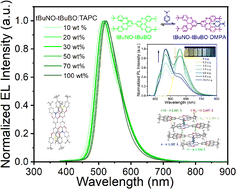
The development of high-performance thermally activated delayed fluorescence (TADF) emitters is significantly hindered by both aggregation-caused quenching (ACQ) and concentration quenching effects under doped or non-doped conditions. Herein, we report a novel TADF emitter, tBuNO–tBuBO, which features a rigid donor–acceptor framework incorporating tert-butyl groups. The steric hindrance and multiple intermolecular interactions enforce an antiparallel stacking conformation, effectively suppressing ACQ effect and enabling concentration-insensitive emission. Solution-processed OLEDs based on tBuNO–tBuBO demonstrate stable external quantum efficiencies (EQEs) across a wide doping range (10–100 wt%), demonstrating an exceptional resistance to ACQ effect, concentration quenching, and remarkable spectral stability. Interestingly, the Lewis acidity of tBuNO–tBuBO enables it to interact with the Lewis base DMAP, inducing significant optical changes that yields white-light emission in dichloromethane. This work proposes a novel strategy to mitigate ACQ and concentration quenching in TADF materials for enhanced electroluminescent and sensing devices.
 Please wait while we load your content...


