


Metal-assisted chemical etching of silicon pore structures to investigate the electrochemical performance of silicon-based anodes
 *a
and
Hui
Yang
*ac
*a
and
Hui
Yang
*ac
Abstract
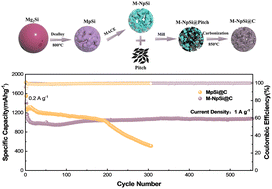
Silicon, as a promising next-generation anode material, faces problems such as volume expansion and low electrical conductivity, which limit its large-scale practical application. Herein, a porous Si/C composite (M-NpSi@C) is prepared from Mg2Si and pitch by tuning the pore structure of Si with metal-assisted chemical etching and carbonizing M-NpSi@pitch composite formation. The prepared porous silicon, M-NpSi-1.0, is rich in pores and has a high specific surface area with suitable particle size and pore distribution, attributed to the appropriate ratio of etchant to MpSi. Such pore characteristics promote effective penetration of the electrolyte to allow Li+ diffusion onto the Si surface, shorten the Li+ diffusion distance to expedite the kinetics, and accommodate volume expansion to prevent Si cracking and even pulverization. Thus, the obtained M-NpSi@C electrode presents not only a high reversible specific capacity of 1077 mAh g−1 after 550 cycles (capacity retention of 85.1%) at 1 A g−1 but also excellent rate capability. At 5 A g−1, the M-NpSi@C electrode can deliver a specific capacity of 527 mAh g−1. This work provides an effective approach for the preparation of porous Si/C composite anodes for high-energy batteries.
 Please wait while we load your content...


