


 PLATFORM UPDATE:


Integration of a symmetric D–A–D chromophore with biocompatible silk fibroin for ultrafast measurement and flexible solid-state lasing
 *a
Tzu-Chau
Lin,
*b
*a
Tzu-Chau
Lin,
*b
Abstract
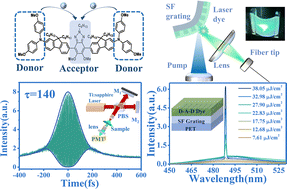
Organic dyes, owing to their variety of superior optical characteristics and excellent film-forming properties, have been widely recognized as promising candidates for the fabrication of various optoelectronic devices. In this work, the nonlinear absorption and lasing characteristics of a high-quality neat film prepared from a custom-designed organic dye with a symmetric donor–acceptor–donor (D–A–D) structure on a silk fibroin (SF) film were investigated. Owing to its pronounced two-photon absorption (TPA) properties, the synthesized neat film functions as an efficient nonlinear medium in a collinear interferometric autocorrelator for measuring the pulsewidth of a passively mode-locked (PML) Ti:sapphire laser. Additionally, a distributed feedback (DFB) laser was fabricated using a cost-effective SF grating replica, created through nanocasting from a blank digital video disc (DVD). The resulting DFB laser exhibited excellent performance, including a tunable lasing wavelength, low lasing threshold, and linearly polarized output. Using a flexible polyethylene terephthalate (PET) substrate, bendable lasing behavior was achieved by subjecting the sample to mechanical bending.
- This article is part of the themed collection: Journal of Materials Chemistry C HOT Papers
 Please wait while we load your content...


