


 PLATFORM UPDATE:


Understanding the charge state of the Eu ion in anti-perovskites: the role of intrinsic defects

Abstract
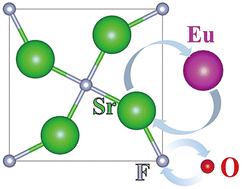
The valence state of the europium ion essentially determines its luminescence in solids. In this work, we focus on the stability of the charge states of the europium ion in the anti-perovskite compound Sr3AlO4F. Previous research showed that only Sr3AlO4F:Eu3+ was synthesized, even under a H2/Ar atmosphere. To understand this phenomenon, we performed a systematic study using topological crystallography, bond valence sum (BVS) and ab initio calculations. The obtained results indicate that the F site of Sr3AlO4F suffers from instability and can be easily replaced by oxygen, which plays a decisive role in determining the charge state of the Eu ion in the host. Experimental synthesis was then conducted following these theoretical analyses. To this end, a H2/C reducing atmosphere was employed to eliminate excess oxygen from the reaction system. Under these reaction conditions, Sr3AlO4F:Eu2+ was synthesized for the first time. The presence of Eu2+ ions was confirmed by X-ray photoelectron spectroscopy and photoluminescence measurements. This work demonstrates the critical role of defect engineering in stabilizing Eu valence states and provides a novel strategy for the design of high-performance phosphors.
- This article is part of the themed collection: Journal of Materials Chemistry C HOT Papers
 Please wait while we load your content...


