


 PLATFORM UPDATE:


Electroluminescence from carbon quantum dots with an ultra-simple structure of metal/insulator/semiconductor

Abstract
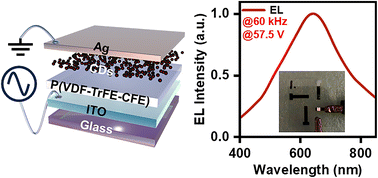
Carbon quantum dots (CDs) offer high photoluminescence quantum yield with low toxicity and cost, but their electroluminescent devices are limited by complex DC driving architectures causing carrier accumulation and energy level misalignment. A light-emitting metal/insulator/semiconductor junction (LE-MISJ) based on CDs, with the structure indium tin oxide (ITO)/P(VDF-TrFE-CFE)/CDs/Ag, is proposed and fabricated. The LE-MISJ is driven by sinusoidal alternating current (AC) signals with varying frequencies and voltages, allowing systematic investigation of the electroluminescence (EL) behavior of CDs under alternating electric fields. Experimental results demonstrate that two emission peaks are generated within a single voltage cycle. The intensities of these peaks correlate with the carrier injection direction, indicating the combined effects of the P-type semiconducting characteristics of CDs and the single-end injection configuration of the LE-MISJ. Variation of driving configurations (forward/reverse connection) and frequency reveals that polarization effects induced by hydroxyl and carboxyl functional groups create a built-in electric field at the Ag/CD interface. This field modulates the energy band structure and affects carrier injection efficiency. A kinetic mechanism for CD luminescence under AC fields is proposed. This approach overcomes the structural complexity of traditional DC-driven CD-LEDs and demonstrates the potential of CDs for next-generation AC-powered EL lighting devices.
 Please wait while we load your content...


