



Crystallographic orientation-dependent anisotropic doping in organic single-crystal microplates
 *b
and
Jiansheng
Jie
*ab
*b
and
Jiansheng
Jie
*ab
Abstract
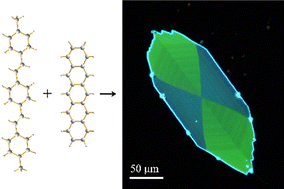
Molecular doping serves as a pivotal method for tailoring optoelectronic properties of organic single crystals. However, the correlation between the anisotropic doping of guest molecules and host crystallographic orientation remains obscure in (quasi-)two-dimensional crystals. Here, we first reveal that the guest molecules dope into the host crystals strictly along their preferred growth orientation, resulting in aggregation of anisotropic guest molecules in organic single-crystal microplates. Pentacene-doped 1,4-bis(4-methylstyryl)-benzene (p-MSB) single-crystal microplates manifest distinct emission regions: blue emission from pristine p-MSB domains, whereas green emission results from pentacene-doping regions, corresponding to the selective doping along the [010] direction. As the doping concentration of guest molecules elevates in the thermodynamically controlled crystal growth process, a clear emission transition from the initial dual-color emission to the single red emission is observed in single-crystal microplates, due to the highly efficient energy transfer from p-MSB to pentacene molecules. Single-crystal microplates exhibit excellent waveguide performance with optical loss coefficients as low as 0.062 dB µm−1. Capitalizing on the strong light-matter interactions and the excellent optical anisotropy, the photodetectors based on single-crystal microplates exhibit a high dichroic ratio up to ∼2.28, exceeding those of several reported one-dimensional nanowires and two-dimensional materials. These findings establish a new avenue for spatially site-selective doping in organic single crystals with tailored optoelectronic properties.
 Please wait while we load your content...


