


 PLATFORM UPDATE:


Glutathione-responsive conjugates of hyperbranched poly-oxidized glutathione and camptothecin for cancer therapy
 *a
*a
Abstract
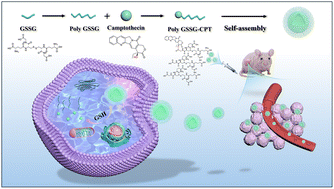
Camptothecin (CPT) is a highly potent antitumor agent; however, it exhibits severe systemic toxicity in clinical application. Herein, we utilized the endogenous molecule oxidized glutathione (GSSG) as a carrier for CPT delivery, aiming to circumvent both the accumulative toxicity of the carrier and the systemic toxicity of the drug. Poly-GSSG was conjugated with CPT to develop a glutathione-responsive nanomedicine (Poly GSSG–CPT). The structure of Poly GSSG–CPT was confirmed via FT-IR, NMR, and MALDI-TOF analyses. The cumulative CPT release rate from Poly GSSG–CPT reached 97.9% after 120 h in a 10 mg mL−1 glutathione (GSH) environment, as measured by UV-vis spectroscopy. CCK-8 assays and flow cytometry experiments demonstrated that Poly GSSG–CPT and CPT exhibited comparable cytotoxic effects against HeLa cells. Furthermore, confocal laser scanning microscopy (CLSM) and in vivo imaging (IVIS) showed that Poly GSSG–CPT could be localized in cell nuclei within 6 h and accumulated in tumor tissue within 48 h. Studies using tumor-bearing mice and histopathological analyses confirmed that Poly GSSG–CPT significantly enhanced antitumor efficacy and reduced systemic toxicity. Altogether, the Poly GSSG–CPT nanomedicine based on GSSG and CPT showed superior stability in an aqueous environment, greater tumor inhibition ability, and fewer side effects in vivo. This work demonstrates that endogenous molecules used as carriers may represent a promising strategy for developing nanomedicine with higher therapeutic efficacy and lower systemic toxicity.
 Please wait while we load your content...


