


Multicolor STED imaging of cells and extracellular vesicles using xanthene-conjugated polymer dots

Abstract
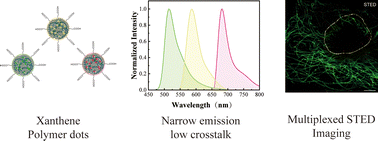
Stimulated emission depletion (STED) nanoscopy enables imaging beyond the optical diffraction limit. However, its performance critically depends on the quality of fluorescent probes. In particular, multichannel STED imaging imposes stringent requirements on probe brightness, photostability, and emission bandwidth. Compared to organic dyes, polymer dots (Pdots) typically exhibit good photostability, but suffer from a weak STED response and spectral crosstalk. To overcome this challenge, we report a general strategy for synthesizing Pdots tailored for multicolor STED imaging. By conjugating xanthene-based fluorophores to polystyrene-based polymer backbones with controlled ratios, we obtained highly emissive xanthene Pdots with minimal aggregation-induced quenching. The resulting tri-color Pdots exhibit high fluorescence quantum yields, excellent photostability, and narrow emission bandwidths. These probes were successfully applied to high-resolution multicolor STED imaging of single particles, cells, and extracellular vesicles, showing a resolution of <100 nm. This work provides a versatile and broadly applicable methodology for developing spectrally tunable, low-crosstalk fluorescent probes for multicolor STED nanoscopy.
- This article is part of the themed collection: Journal of Materials Chemistry B Emerging Investigators 2026
 Please wait while we load your content...


