


Development of a sustained anticancer drug delivery system based on hybridization between diatomite and nanostructured lipid carriers

Abstract
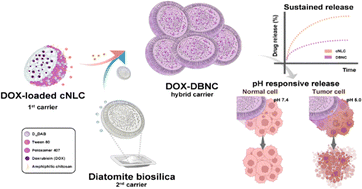
Newly developed anticancer drugs are generally highly hydrophobic, reflecting design strategies aimed at achieving high receptor selectivity and enhanced pharmacological efficacy. This inherent hydrophobicity commonly results in low bioavailability, characterized by poor aqueous solubility and limited cellular uptake, which are associated with unfavorable pharmacokinetic characteristics. To address these limitations, advanced drug delivery systems (DDS) capable of prolonging drug half-life and enabling controlled, site-specific release are required. In this study, a pH-responsive hybrid DDS was developed by integrating porous diatomite biosilica (DB) with amphiphilic chitosan-coated cationic nanostructured lipid carriers (cNLC). The cNLC formulation was optimized by tuning the surfactant content, resulting in a drug encapsulation efficiency of 98.27 ± 1.73%. The drug-loaded cNLC was immobilized onto the DB via electrostatic interactions, localizing within its pores and on its surface. The DB–cNLC composite (DBNC) exhibited sustained drug release under physiological conditions and enhanced release under mildly acidic conditions mimicking the tumor microenvironment. In vitro cellular assays demonstrated enhanced cytotoxicity of doxorubicin-loaded cNLC (DOX–cNLC) compared with free DOX, and the DBNC further prolonged DOX exposure and therapeutic efficacy. These findings suggest that the DBNC system holds promise as a pH-responsive DDS to improve the bioavailability and therapeutic duration of hydrophobic anticancer drugs.
- This article is part of the themed collection: Journal of Materials Chemistry B HOT Papers
 Please wait while we load your content...


