


BSA-mediated proton-coupled electron transfer to unlock the photogeneration of hydroxyl radicals in cancer cells
 a
Hongping
Zhou
*ab
a
Hongping
Zhou
*ab
Abstract
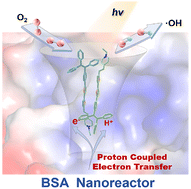
The unique attributes of proteins—including their confined nanoscale cavities, abundant redox-active amino acid residues, and excellent biocompatibility—offer significant advantages for constructing protein-based enzymatic systems. However, their potential remains underexplored in photosensitization systems for shifting the photosensitization pathways. Here, we report a bovine serum albumin (BSA)-based photosensitizing system, termed TC2@BSA, in which the BSA nanoreactor mediated a proton-coupled electron transfer (PCET) process to unlock the photogeneration of hydroxyl radicals (˙OH) in cancer cells. The photosensitizer TC2, which was inherently incapable of generating ˙OH, was encapsulated within the subdomain IIA of BSA in a more planar and compact configuration and stabilized by hydrophobic interactions, π–π stacking, and hydrogen bonding. Isotope labeling, electron paramagnetic resonance (EPR) spectroscopy, and electrochemical experiments confirmed that the photo-disproportionation of the encapsulated TC2 coupled with the PCET process of the BSA nanoreactor led to ˙OH generation and enhanced photostability. TC2@BSA generated abundant ˙OH and demonstrated remarkable photocytotoxicity against cancer cells. This study opens a new avenue for the design of biocompatible protein-based photosensitizers.
 Please wait while we load your content...


