


Particle accumulation and medullary expansion associated with LA103Z magnesium alloy degradation in a rat intramedullary model
 *a
*a
Abstract
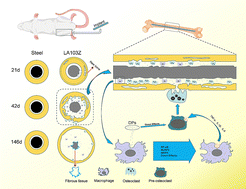
Magnesium alloys have gained significant attention in the field of orthopedic internal fixation due to their biodegradable properties and favorable mechanical compatibility with bone. However, their long-term tissue response in a confined bone environment remains unclear. In this study, LA103Z magnesium alloy rods were implanted into the femoral medullary cavity of rats to evaluate the in vivo degradation behavior and bone tissue responses. Micro-computed tomography (µCT) analysis revealed a biphasic degradation pattern, with a rapid early phase followed by a slower late phase. During degradation, abundant micron-sized particles (0.4–4.3 µm) formed within the medullary cavity, with a distribution that strongly correlated with the formation of bone resorption cavities and medullary expansion. Histological and western blot analyses showed elevated expression of M1 macrophage markers (iNOS) and pro-inflammatory cytokines (TNF-α and IL-1β), accompanied by enhanced osteoclast activity. Although some periosteal osteogenesis was observed in the early stages, endosteal bone resorption gradually dominated. These results suggest that degradation of the LA103Z magnesium alloy is strongly associated with bone resorption and medullary expansion in the confined intramedullary environment. Based on these observations, we propose a mechanistic hypothesis that micron-sized particles generated during degradation may contribute to local bone remodeling via an inflammation–osteoclast axis. However, this study is primarily based on spatiotemporal correlations, and further experimental interventions are needed to validate the causal relationship. This study provides new insights into the biological behavior of magnesium alloys in specific anatomical environments and offers experimental evidence for the safety assessment of their clinical applications.
 Please wait while we load your content...


