


 PLATFORM UPDATE:


MoS2 phase transition-assisted sensitive detection of cholesterol on a copper oxide@molybdenum disulfide nanocomposite
 †a
and
N.
Sandhyarani
*a
†a
and
N.
Sandhyarani
*a
Abstract
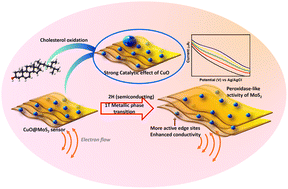
The development of nonenzymatic cholesterol sensors is essential for overcoming the stability and cost constraints inherent in traditional enzyme-based assays. In this work, we report the synthesis of a CuO@MoS2 nanocomposite via a combined exfoliation-hydrothermal and sonication approach. This strategy successfully integrates ultrasmall CuO nanoparticles onto the surface of exfoliated MoS2 nanosheets, creating an optimised interface for rapid charge transfer. Structural and electrochemical analysis reveals that cholesterol oxidation triggers a decisive partial phase transition in MoS2, shifting it from the semiconducting 2H phase to the highly conductive metallic 1T phase. This in situ transformation significantly enhances electron mobility and catalytic kinetics, resulting in excellent sensing performance. The sensor demonstrates high sensitivity, a remarkably low limit of detection of 26.25 × 10⁻⁴ mg dL−1 and excellent selectivity against common interferents in complex biological fluids. The sensor is successfully validated using whole blood and human serum samples, even at high concentrations. The synergistic effects of high-surface-area nanosheets and electrochemically induced phase modulation make this CuO@MoS2 sensor platform a robust and scalable solution for next-generation clinical assays and point-of-care diagnostic devices.
 Please wait while we load your content...


