


An amylase-responsive bilayer film for sustained enzyme delivery and ROS-scavenging therapy in oral ulcer treatment

Abstract
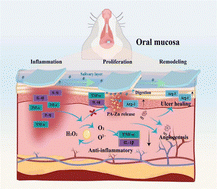
Oral ulcers are prevalent mucosal disorders, yet the clinical efficacy of current biomaterial-based therapies is often hindered by insufficient oral retention time and suboptimal drug bioavailability. To address these limitations, an innovative amylase-responsive bilayer composed of a starch–pectin matrix coated with catechol–zinc (PA–Zn) nano-enzymes was developed for controlled enzyme release within the oral cavity (PZ/SP). This system utilizes salivary amylase to trigger the progressive degradation of the inner starch layer, ensuring a sustained release of therapeutic enzymes while the outer pectin layer maintains structural integrity. The film demonstrates dual-phase therapeutic action: effective scavenging of reactive oxygen species (ROS) via superoxide dismutase (SOD)-mimicking activity and modulation of inflammatory responses by promoting macrophage polarization from the pro-inflammatory (M1) to the anti-inflammatory (M2) phenotype. In vivo studies in murine oral ulcer models confirmed that the PZ/SP film significantly extends enzyme retention, reduces oxidative stress, and accelerates healing through enhanced re-epithelialization and angiogenesis. This responsive biomaterial platform addresses key limitations of existing treatments and offers a promising strategy for oral mucosal regeneration.
 Please wait while we load your content...


