


 PLATFORM UPDATE:


Stimuli-responsive phenothiazine–tetraphenylethylene hybrid luminogens: mechano- and piezochromic properties with anticancer applications

Abstract
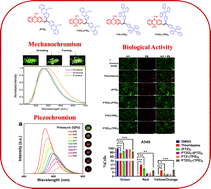
Mechanochromic and piezochromic luminogens represent a class of stimuli responsive materials, in which the emission colour or intensity changes reversibly in response to external mechanical force or pressure. Herein, we have reported the solid state photophysical properties of (PTZ)3, PTZO2-(PTZ)2, PTZ-(TPE)2, and PTZO2-(TPE)2 under external mechanical force and pressure, exhibiting reversible changes in emission colour. Notably, an excellent piezochromic response is achieved under applied pressure, exhibiting a large and reversible emission shift, demonstrating high sensitivity of these compounds towards external pressure. The incorporation of two phenothiazine units or two tetraphenylethylene units on the vinylic carbon atom produces steric crowding, which causes non-planarity and results in enhanced emission in the solid state. The compounds (PTZ)3, PTZO2-(PTZ)2, PTZ-(TPE)2, and PTZO2-(TPE)2 were evaluated for their biological activities, exhibiting bright fluorescence suitable for imaging and notable cytotoxicity against different cancer cell lines, indicating their potential anticancer activity. The compound (PTZ)3 shows a moderate anticancer effect, likely mediated through lysosomal autophagic pathways, while its oxide form PTZO2-(PTZ)2 significantly reduces this effect. These results highlight the multifunctional potential of these molecules, integrating stimulus-responsive luminescence with anticancer functionality.
 Please wait while we load your content...


