


Study on the effect of phosphate-doping in wollastonite scaffolds on their physicochemical properties and critical calvarial defect repair
 *ac
*ac
Abstract
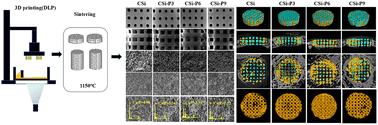
The reconstruction of critical-size skull defects is challenged by the limited availability of autologous bone grafts and the mismatch between degradation rate and new bone formation in synthetic scaffolds. Wollastonite (CaSiO3; CSi), despite its favorable bioactivity, suffers from rapid degradation and inadequate structural stability, hindering its clinical application. In this study, we conducted systematic parameter optimization by fabricating a series of 3D-printed wollastonite scaffolds with uniform phosphate-doping levels (CSi-Px, where x = 0, 3, 6, and 9 mol%) via digital light processing (DLP). Our objective was to identify the optimal doping concentration that best balances the scaffold's degradation behavior with its osteogenic capacity. The scaffolds were characterized in terms of pore structure, compressive strength, in vitro degradation and re-mineralization capacity. Cell proliferation and osteogenic differentiation experiments were conducted using bone marrow mesenchymal stem cells (BMSCs). In particular, the bone regeneration efficacy was evaluated in a rabbit cranial defect model over a 12-week period. The results indicated that phosphate doping significantly promoted the proliferation and osteogenic differentiation of bone marrow mesenchymal stem cells (BMSCs), enhanced the mineralization capacity of the scaffold, reduced the in vivo degradation rate of the calcium silicate scaffold, and maintained its structural and morphological stability, thereby providing improved osteoconductive capability. The phosphate content significantly influences bone repair outcomes by modulating the degradation behavior and bioactivity of CSi, and 6% phosphate doping is identified as the optimal content, which may balance the structural stability, biodegradation rate, and potent osteogenic capacity. This study provides quantitative design guidelines for developing calcium–silicon–phosphorus (Ca–Si–P)-based bioceramics.
 Please wait while we load your content...


