


 PLATFORM UPDATE:


Carrier-free water-soluble porphyrin nanoparticles as highly effective photosensitizers for photodynamic therapy
 a
Wenwu
Cao
*a
a
Wenwu
Cao
*a
Abstract
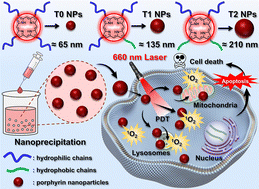
With the fast development of precision medicine, porphyrin-based photosensitizers (PSs) have been extensively employed in photodynamic therapy (PDT). However, their poor water solubility and aggregation-induced self-quenching during reactive oxygen species (ROS) generation result in less satisfactory therapeutic outcomes. Herein, three novel porphyrin derivatives have been successfully synthesized through adjusting the ratios of hydrophilic and hydrophobic side chains, and ultimately three different sizes of carrier-free porphyrin nanoparticles (NPs) have been prepared by nanoprecipitation. The three porphyrin NPs exhibited good water dispersion, stable photophysical properties, and showed a higher efficiency in singlet oxygen (1O2) generation than traditional porphyrin-based PSs under 660 nm laser irradiation. Among them, T2 NPs exhibit the highest phototoxicity during in vitro cell experiments, attributed to their effective cellular uptake, high intracellular ROS yields, and specific localization in the mitochondria and lysosomes of T2 NPs in tumor cells. Moreover, in vivo animal experiments further confirmed the outstanding antitumor activity of T2 NPs under PDT treatment, along with excellent biocompatibility and biosafety. This study provides a promising strategy for utilizing modified water-soluble porphyrin NPs as highly effective PSs, demonstrating great potential in enhancing PDT efficacy.
 Please wait while we load your content...


