


Combating food spoilage by tackling drug resistance: sulfur-doped carbon nanozymes as effective tomato coatings

Abstract
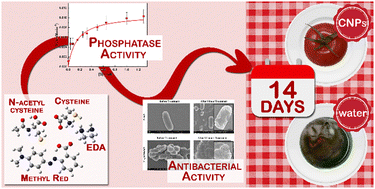
The development of safe, effective preservatives that avoid fostering drug resistance remains a significant challenge for prolonging the freshness of fruits and vegetables. Addressing this, we synthesized two distinct carbon-based phosphatase nanozymes (CNPs) from methyl red dye using L-cysteine (L-Cys) or N-acetyl-L-cysteine (NAC) as sulfur-containing precursors. These CNPs exhibited potent, broad-spectrum antimicrobial activity against Gram-negative Escherichia coli and Gram-positive Staphylococcus epidermidis, with a minimum inhibitory concentration (MIC) of 125–250 µg mL−1. As opposed to the most conventional reactive oxygen species (ROS)-based antimicrobial mechanism, the present work proposed a mechanism based on robust phosphatase-mimetic activity. It catalyzes the non-specific dephosphorylation of phosphate groups in the bacterial outer membrane and cell wall, and pioneers the development of antimicrobial agents against Gram-negative bacteria. The L-Cys-derived CNPs demonstrated superior phosphatase activity and correspondingly stronger antibacterial efficacy. At the MIC, this nanozyme effectively prevented mold growth on tomatoes for 14 days, significantly extending their shelf life. This work highlights the promise of carbon phosphatase nanozymes as a novel class of potential resistance-resistant antimicrobial agents for agricultural applications.
 Please wait while we load your content...


