


 PLATFORM UPDATE:


Asymmetric coupling induces spin-flipping in the NiFe-MOF cocatalyst for boosting the BiVO4 photoanode water oxidation
 *a
*a
Abstract
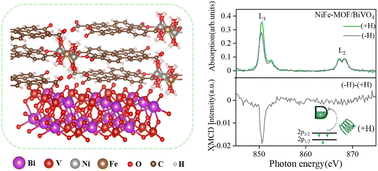
Water splitting via a photoelectrochemical (PEC) system is a promising approach for sustainable hydrogen production. However, photogenerated charge accumulation and recombination impede the water oxidation kinetics due to not only the four-electron transfer process but also the oxygen spin state change. Here, a modulation of spin state in a NiFe-based metal–organic framework (NiFe-MOF) cocatalyst is employed on BiVO4 photoanodes to accelerate the interface kinetics. X-ray magnetic circular dichroism combined with spin-polarized density functional theory calculations reveal that Fe incorporation induces a spin-state transition of the Ni dz2 orbital (dz2↓ to dz2↑) through asymmetric Fe–O–Ni bond coupling within the MOF nodes. The resulting downward shift of the Ni dz2 energy level weakens the adsorption of oxygenated intermediates (*OH/*OOH) on Ni sites, thereby facilitating *OOH desorption and O2 release during oxygen evolution. Consequently, the NiFe-MOF/BiVO4 photoanodes exhibit a significantly enhanced PEC performance, delivering a photocurrent density of 6.0 mA cm−2 at 1.23 V versus the reversible hydrogen electrode (RHE) under simulated sunlight. This work highlights asymmetric metal–oxygen bond-driven electron spin engineering as an effective strategy to boost the PEC activity.
- This article is part of the themed collection: Journal of Materials Chemistry A HOT Papers
 Please wait while we load your content...


