


 PLATFORM UPDATE:

A high-entropy iron-based perovskite rich in oxygen vacancies for efficient oxygen reduction in intermediate-temperature SOFCs

Abstract
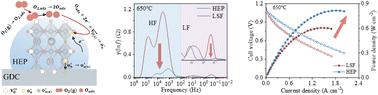
Perovskite-type La0.8Sr0.2FeO3−δ (LSF) is a competitive cobalt-free cathode candidate for solid oxide fuel cells (SOFCs), but its sluggish oxygen reduction reaction (ORR) kinetics at intermediate temperatures severely hinders practical application. Elevating oxygen vacancies in LSF by elemental doping represents an efficient approach to boost its ORR activity. This study reports a novel Fe-based high-entropy perovskite cathode (HEP), La0.29Sr0.20Pr0.13Nd0.15Ba0.15FeO3−δ, with abundant oxygen vacancies. The area-specific resistance of the HEP (0.089 Ω cm2) is only 14% of that of the LSF at 700 °C. Meanwhile, the single cell with the HEP achieves a peak power density of 1.172 W cm−2 at 700 °C, a 28% increase over the LSF-based cell. Systematic characterization studies and electrochemical tests reveal that Pr, Nd, and Ba dopants and A-site deficiencies, acting collectively as acceptor dopants, are incorporated into the LSF lattice. This resulted in abundant oxygen vacancies in the cathode that provide active sites for oxygen adsorption and accelerate surface charge transfer, thereby significantly boosting ORR kinetics. The development of the novel HEP cathode material lays a critical foundation for designing high-performance perovskite cathodes and advancing the industrialization of SOFCs.
- This article is part of the themed collection: Journal of Materials Chemistry A HOT Papers
 Please wait while we load your content...


