


 PLATFORM UPDATE:

LDH/oxide heterostructures as p–n type electrocatalysts for alkaline water splitting: an experimental assessment via a temperature-dependent study

Abstract
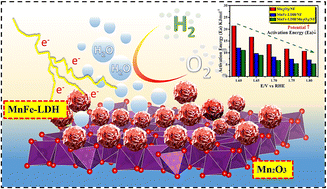
Understanding reaction kinetics and catalytic mechanisms plays a pivotal role in developing low-cost materials for the water-splitting reaction. Herein, a hierarchically structured MnFe-LDH/Mn2O3 heterostructure was fabricated on Ni foam using a facile hydrothermal synthesis route, which showed higher HER and OER performance in alkaline media, where MnFe-LDH and Mn2O3 act as n- and p-type semiconducting materials, respectively. Furthermore, the heterostructure exhibits excellent selectivity with a faradaic efficiency as high as 93.31% at 1.61 V potential. In addition, the electrocatalyst exhibits stable performance for 36 h at 1.56 V, signifying its sturdiness. The reaction kinetics were evaluated via a temperature-dependent study, revealing enhanced OER kinetics of the MnFe-LDH/Mn2O3 heterostructure as compared to bare MnFe-LDH and Mn2O3. The activation energy of the heterostructure material (5.37 kJ mol−1) is reduced to half that of pristine Mn2O3 (10.7 kJ mol−1) at a potential of 1.8 V, and a pH-dependent study confirms that the MnFe-LDH/Mn2O3 heterostructure follows the reaction pathway via the adsorbate evolution mechanism (AEM) instead of the lattice oxygen mechanism (LOM). This work provides an alternate approach to elucidate the reaction kinetics and catalytic mechanism for the development of an efficient bifunctional electrocatalyst toward water splitting applications.
 Please wait while we load your content...


