


 PLATFORM UPDATE:


Spectroscopic evidence for directional oxygen-ion transport in correlated oxide heterostructures with tunable migration dynamics
 *ab
*ab
Abstract
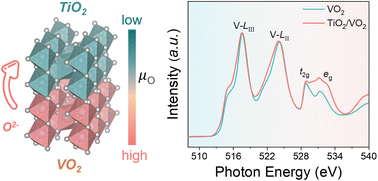
Oxygen chemical potential mismatch (ΔµO) spontaneously drives directional ionic transfer across oxide heterointerfaces, offering a facile route to introduce oxygen deficiencies beyond the traditional thermal stimulus in monolayer materials. Here, we provide compelling spectroscopic evidence for directional oxygen-ion transport in a TiO2/VO2 heterostructure, driven by a built-in ΔµO gradient, uncovering critically balanced Peierls–Mott physics. Given the exceptional sensitivity of VO2 to external stimuli, the band filling in the t2g band of VO2, together with the suppression of V–V dimerization, is clarified using synchrotron and Raman spectroscopy techniques, circumventing artifacts typically introduced by electron-beam illumination. Oxygen off-stoichiometry in the TiO2 overlayer functionalized as an oxygen reservoir is identified as a powerful tuning knob for actively accelerating ionic transport dynamics. By harnessing the symmetry mismatch between VO2 and Al2O3, either the inclined or vertically aligned domain-boundary configuration achieved in VO2 can offer an efficient pathway for oxygen-ion diffusion, extending the horizons of material design for iontronic devices. Our findings establish a feasible strategy to controllably manipulate oxygen-ion transport in oxide heterostructures, driven by the ΔµO gradient, while offering direct spectroscopic evidence that deepens the understanding of defect-associated correlated physics.
 Please wait while we load your content...


