


 PLATFORM UPDATE:


Potential-dependent NRR/HER competition and N2 activation mechanism in M1M2@C6N6 bimetallic catalysts

Abstract
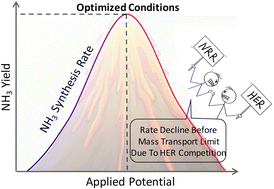
The performance decay of the electrochemical nitrogen reduction reaction (eNRR) at negative potentials is a primary obstacle to industrial implementation, which is predominantly attributed to the competition from the hydrogen evolution reaction (HER). In this work, a novel tiered screening strategy is proposed by integrating the computational hydrogen electrode (CHE) model and grand canonical ensemble constant-potential simulations to systematically investigate the potential-dependent competition of NRR and HER on M1M2@C6N6. Among 55 candidate catalysts, ScMn@C6N6 and VFe@C6N6 possessing high activity and selectivity are screened out, since they maintain a thermodynamic advantage for N2 adsorption over a broad potential window. The equilibrium potential (Ueq) is defined as a critical benchmark to quantify the transition from N2-dominant to H-dominant adsorption, which provides a rational explanation for the premature decline in NRR yield before reaching the mass transfer limit. Furthermore, a dual-pathway strategy is constructed to identify the decisive role of interatomic distance by interpretable Machine Learning (ML), and derive novel descriptors for understanding N2 activation by symbolic regression. This research establishes a comprehensive theoretical framework and methodological guidance for rational design of highly selective electrocatalysts under realistic reaction conditions.
 Please wait while we load your content...


