


 PLATFORM UPDATE:


Microenvironment engineering of catalytic pockets in copper paddle-wheel-based hypercrosslinked microporous polymers for highly selective CO2 photoreduction
 a
and
Pengfei
Li
*abc
a
and
Pengfei
Li
*abc
Abstract
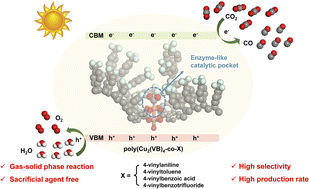
Precise modulation of the local microenvironment surrounding metal active centers constitutes a powerful strategy for optimizing the performance of photocatalytic CO2 reduction. In this work, a series of hypercrosslinked microporous polymers incorporating paddle-wheel copper benzoate moieties were rationally designed and synthesized. By introducing para-substituted styrene comonomers with distinct functional groups (–NH2, –CH3, –CO2H, and –CF3), the microenvironment surrounding Cu active sites was delicately and systematically regulated. Benefiting from significantly improved photogenerated charge separation efficiency and favorable surface hydrophobicity, poly(Cu2(VB)4-co-VBTF)-3 exhibits a CO production rate of 21.8 µmol g−1 h−1 with nearly 100% CO selectivity under gas–solid conditions without any sacrificial agent, representing a 3.6-fold activity enhancement compared with the Cu2(VB)4 monomer. This microenvironment engineering strategy offers a new avenue for the precise design of metal active sites in porous polymeric photocatalysts and provides important insights for developing efficient solar-driven CO2 conversion technologies.
 Please wait while we load your content...


