


 PLATFORM UPDATE:


Eutectic cleavage of lignocellulosic biomass to incubate pseudo-graphitic carbon crystallites for high-efficiency sodium energy storage
 *ab
*ab
Abstract
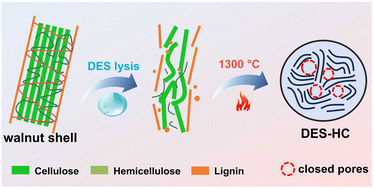
Lignocellulosic biomass represents a promising class of precursors for producing commercially viable hard carbons owing to its resource abundance, renewability, and sustainability. However, the compositional complexity makes it challenging to rationally regulate its desired carbon microstructure for use in sodium-ion batteries. In this work, we propose a lignocellulosic cleavage strategy to incubate pseudographitic carbon crystallites at the molecular level by green eutectic chemistry. The molecular cleavage of cellulose, hemicellulose, and lignin promotes the formation of pseudographitic carbon crystallites with short, twisted, and expanded graphene interlayers as well as rich closed pores. The structurally favorable feature affords plentiful active sites and smooth ion diffusion channels for high-efficiency sodium energy storage. Impressively, the sodiation capacity is greatly increased to 326 mA h g−1 with an enhanced initial coulombic efficiency of 85.4% and excellent rate/cycling performance. Advanced in situ/ex situ techniques are conducted to elucidate the enhanced interfacial kinetics and the underlying reaction mechanism. The present study underscores the importance of the proposed lignocellulosic cleavage method to achieve high-performance biomass-derived hard carbons for advancements in sodium technology.
- This article is part of the themed collection: Journal of Materials Chemistry A HOT Papers
 Please wait while we load your content...


